
Advert
Advert
Join CIPR
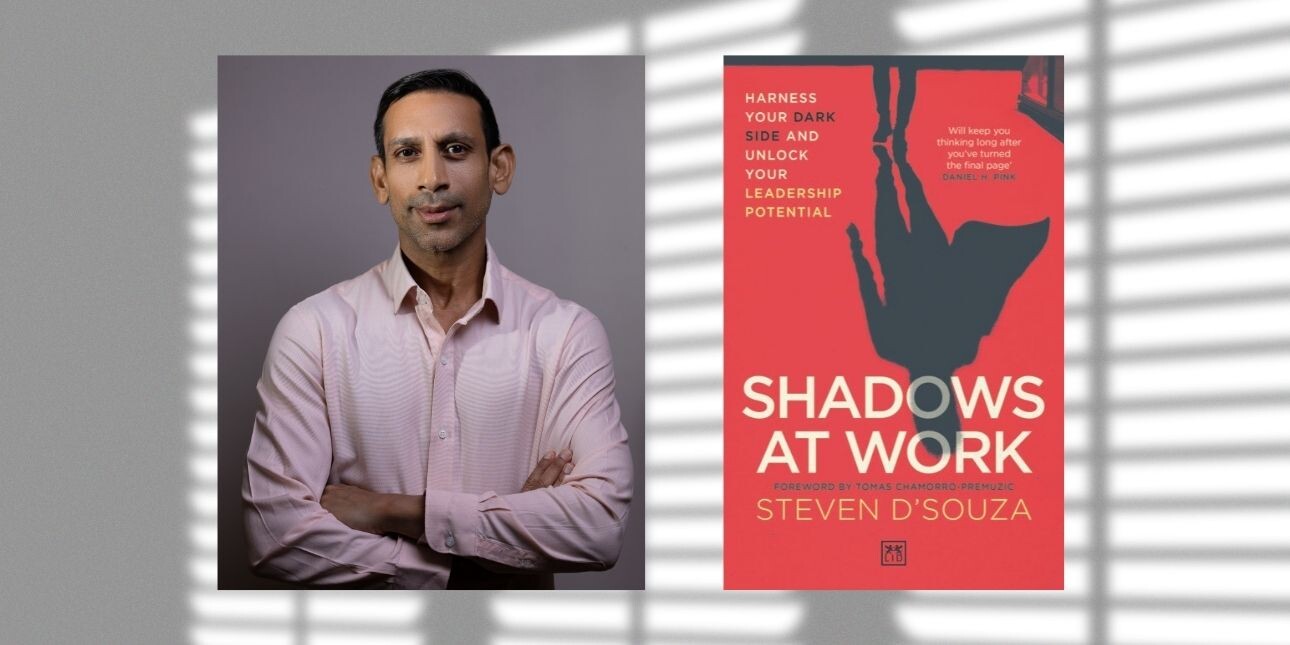
A composite of two images on a background of shadows cast by venetian blinds. On the left a colour portrait of Steven D'Souza wearing a pink shirt. To the right, the red front cover Shadows at Work.
Steven D'Souza is an executive coach and author. (Image: Handout.)
INTERVIEWS
Friday 26th September 2025

10 minute read

Why do people suddenly fail in their career?

From jealousy to self-sabotage, it’s easy to ignore our dark side, but as author and leadership coach Steven D’Souza explains, suppression can set PR professionals up for a fall.

An award-winning executive coach, leadership expert and author of five bestselling books, Steven D’Souza has worked with leaders from Amex to the Financial Times, Goldman Sachs to Eurostar. His method blends philosophy, psychology and spirituality, while his new book Shadows at Work encourages leaders to embrace their ‘dark side’ to unlock their full potential.

D’Souza has had a diverse life journey: he originally trained as a Catholic priest, before becoming a senior partner at Korn Ferry – forging a unique leadership philosophy along the way. As a hugely respected executive coach, he has delivered transformative talks and workshops for the United Nations among other prestigious platforms, while his acclaimed book, Made in Britain, was personally presented to King Charles.

Described as “bold, liberating and essential”, his latest book, Shadows at Work invites leaders to embrace their ‘dark side’ – hidden aspects of ourselves, such as defensiveness, jealousy, or self-sabotage, that we so often relegate to the unconscious. 

Instead, he encourages honest self-reflection, arguing that we need to be as familiar with our shadows as with our light. Rather than suppressing these sides, we must recognise and integrate these behaviours to become more authentic, compassionate and effective leaders (not to mention better human beings). 

I've always struggled with the question: what does it mean to live a good life? I was raised Catholic. If you've been raised Catholic, you’ll know it’s like a PhD in guilt, shame, forgiveness, and compassion. 

I decided to pursue a vocation to the priesthood. I learned more about the complexity of human life than any book could teach. I spent a year doing youth work, a year working in an Alzheimer's unit, teaching in Glasgow’s East End, and working in a mental prison in Scotland. I studied philosophy, theology, history, ancient Greek, and victimology.

Eventually, I left the priesthood training; it wasn't the answer for me about what a good life looks like.

I have worked with hundreds of leaders across many companies and became intrigued by why people derail. Why do people suddenly fail in their career or their team? Research by Gartner shows between 50-70% of CEOs derail within their first 18 months. So why is that? And it’s not always about bad apples. I became curious how culture shapes entire environments that tolerate toxic behaviours. Toxic cultures lead to failures – and even fatalities. 

I've seen NGOs with toxic cultures and companies with highly engaged cultures. This paradox led me to ask: what creates a positive culture?

I began Shadows at Work with the story of Michael Tippett, the British composer imprisoned in Wormwood Scrubs. He was imprisoned because he was a conscious objector during the second world war. He wanted to understand why we have violence and hatred of the Other in our society, and how could we help reduce this polarity? He wrote a beautiful libretto called A Child of Our Time, in the aftermath of Kristallnacht. One of the lines of the oratorio is "I would know my shadow and my light, so shall I at last be whole.” That really stood out for me.

At a time when we're more divided across the political spectrum than we ever were in the past, embracing our shadows is vital.

The biggest myth is that the shadow is negative. Carl Jung likened it to an archetype containing everything repressed or deemed inappropriate. For example, a child told "don’t be selfish" might grow up overly giving and neglecting their own needs.

In his 1951 novel Requiem for a Nun, the American essayist William Faulkner wrote, “The past is never dead – it’s not even past.” And it continues to influence your life in unexpected ways. We're not the rational human beings that we think we are. 

Jung wrote about the idea of the Golden Shadow – the idea that it's not just the negative or painful things that are suppressed, but it's also our gifts and our potential. So for example, if you were told, not to be “a show off” that might have influenced how you express yourself in meetings.

When we look at shadow behaviour, it isn't that people are trying to do negative things. They're not going to work with intention of causing harm, they might be overplaying strengths – this is the most common derailment. So somebody can be very decisive, but when they're stressed, they're impulsive. 

When we look at the shadow, we definitely need to think about the collective as well as individual, and we need to attend to what are the behaviours that we're seeing in companies, in teams, in organisations, rather than only thinking about bad faith actors.

When there’s a reputational issue, what normally happens is that [PR professionals] issue a statement saying, “we have learned the lessons,” and they quickly move on because they don’t want any more attention and time given to what went wrong. 

The value however is stopping enough to look back and say, what could we have changed? What could have been improved? To make sure that there's enough time to not forget the organisational history so that we're learning from the past.

Cultural change normally takes much longer than we think. It's not an overnight job. You need to change the incentives. You need to change the goals. You need to change the way that people are collaborating rather than competing. 

If I see somebody always blaming the other person, always deflecting, always being defensive, then I would maybe question they likely haven't done their own shadow work and they're not able to acknowledge their own shadow.

People who have faced their shadow as well as their light are less reactive, less judgmental. They’re more compassionate and more empathic. They're open to evaluating their own views and to acknowledging their part in the mess.

If there's one thing that I would want readers to take away from the book, it's this idea that when we have looked into our own shadow and we have accepted it in some way, and we're not rejecting our unwanted self, then we find that we have less to project onto others. We become less judgmental, we become more able to empathise, kinder to ourselves and to others and better leaders. 

A black and white photograph of Lysanne Currie. Lysanne is a white woman with shoulder length hair. She wears a striped top.Lysanne Currie is the editor of Influence. She previously edited Director magazine for the Institute of Directors and Sky magazine for British Sky Broadcasting. Lysanne is the founder and CEO of content agency Meet the Leader.


Take the next step in authentic leadership

Join us at the CIPR Leadership & Impact Conference on 13 November in London (or via live stream from the main stage) to explore how leaders can embrace authenticity to shape the future of PR.

Don't miss these long reads

'The corporate backlash on DEI initiatives is demoralising' - Helen Bazuaye

Networking for PR professionals: a how-to guide

10 ways PRs should be using LinkedIn now the algorithm has changed