

Advert
Advert
Join CIPR
CPD Points
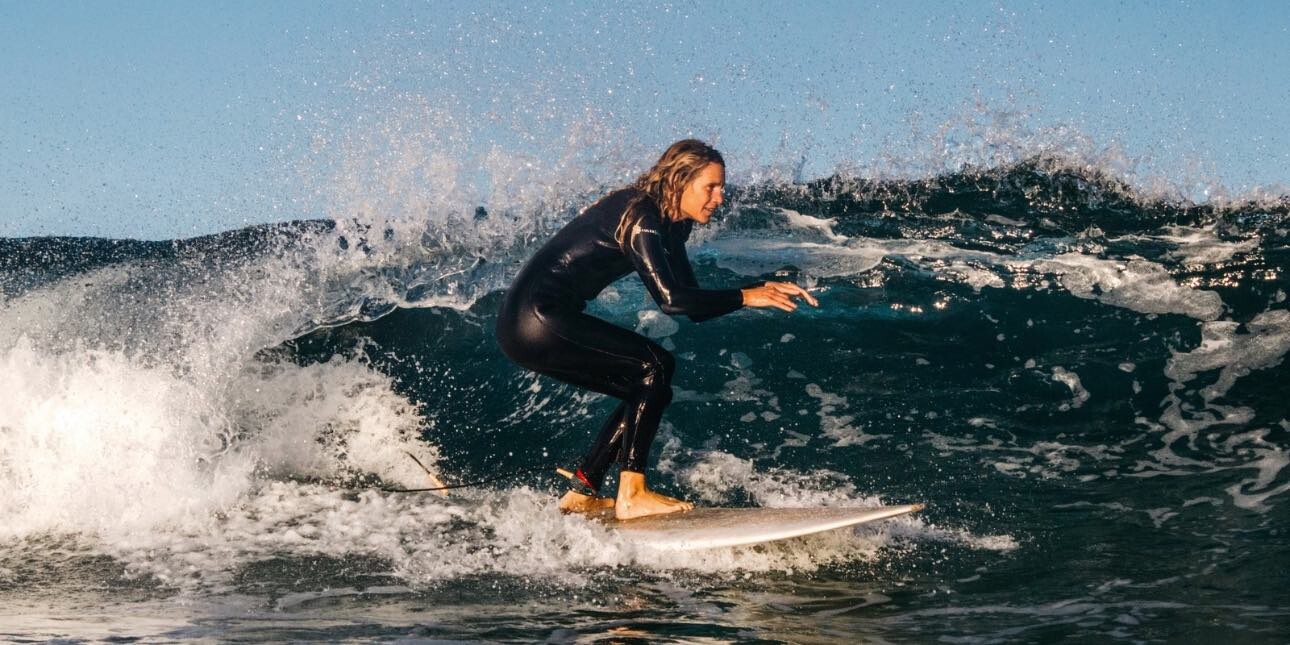
A white female surfer wearing a black all body wetsuit surfing along calm waves with a blue sky behind her
Finisterre
PUBLIC RELATIONS
Friday 3rd October 2025

10 minute read

How surf wear brand Finisterre maximised PR impact by challenged stereotypes

Surfing has traditionally depicted women as bikini-clad ‘babes’ but Cornish outdoor apparel firm is subverting stereotypes through inclusive swimwear, female gaze imagery and traditional PR . . .

Selling surf has – let’s be honest – has long been marred by regressive gender stereotyping. Even today, adverts, films and magazine spreads will feature ripped, bronzed males charging into gnarly waves, while their female counterparts are typically slim, blonde and sporting a bikini – rather than shown as athletes known for their surfing ability. Watch a surf movie from the early-1960s – an era where ‘surfer girls’ were portrayed as giggling groupies – and it seems little has changed. 

Over the last 22 years, one Cornish brand has been paddling against the tide. Operating from a clifftop workshop in St Agnes, north Cornwall, outdoor apparel brand Finisterre has consistently challenged the way women are represented in surf, whether through gender-neutral photography, sponsoring female filmmakers or developing sustainable swimwear that’s available in full-coverage options including hijabs.  

“We’re definitely an outlier,” says Bronwen Foster-Butler, Finisterre’s chief marketing officer. “Even today, if you go on the Instagram accounts of some of the world’s biggest surf brands, the majority of women will be in bikinis.”

Finisterre’s female-friendly stance is a breath of fresh air in a surf culture that outwardly champions equal-opportunity, ‘hang loose’ vibes but is often more of a ‘broligarchy’ than it seems. Many female surfers report being ‘dropped in on’ (having their waves taken) or being verbally insulted by men. 

“Every day out in the waves female surfers face this internalised misogyny where the immediate gut reaction [of many men] is that women are beginners and don’t belong in the sea,” says Foster-Butler. “It wears down on women. Many enter the sport but leave quite quickly because it doesn’t feel like a safe space for them to be, or somewhere they can thrive.”

Life through a lens

One of the ways Finisterre’s marketing and PR combats this chauvinism is using promotional photography and imagery which has been shot and designed with the female gaze in mind usually by staff photographer Abbi Hughes. The brand has creative brand guidelines on the female gaze for employees and collaborators.  

“Because there can be a learned bias towards shooting women in a particular way, when we work with new freelancers [the Finisterre guidelines] start a conversation that we’ll show women as athletes and participants, not just bodies on display,” says Foster-Butler. “In the outdoors industry, there’s been a tradition of [showing] (usually white) men conquering mountains while women wear something pink and run through a field. We always look for subtleties such as: is the woman always following the man or is she leading? Or does the woman’s bag look as heavy as the one the man is carrying?”

Because women are underrepresented in the surf industry, Finisterre is promoting stories about female surfers through its Women Of The Sea film fund. Every year, they invite female filmmakers to submit a pitch celebrating “the bravery and fortitude shown by women of the sea”, with the winner receiving a £10,000 grant. Previous winners have included Salt (Alice Ward) which showed the filmmaker use the sea to manage her cystic fibrosis or The Granny Grommets (Leah Rustomjee), which followed over-50s female surfers in Western Australia. 

A black and white photo with four people standing in the sea smiling nand wearing wetsuits and swimwear. The women in the middle holds a camera in her hand
Abbi Hughes on a photoshoot
Credit: Nick Pumphrey / Finisterre

Radical inclusivity 

If Finisterre are doing things differently in surf, that’s because they are different. The company is a ‘cold-water surf’ brand, specialising in selling gear and clothing for low-temperature surfing conditions (Finisterre takes its name from the Shipping Forecast. Finisterre used to be one of the sea areas but it's now called Fitzroy.). 

“The very nature of us being a cold-water surf brand is counter to surf culture, which is dominated by brands from California, Australia or Hawaii, and focuses on bikinis, boardshorts and turquoise waters,” says Foster-Butler. “Being more radical around inclusivity is just a natural extension.”

The brand was initially founded selling fleeces by Tom Kay in 2003. “Tom felt the surf industry wasn’t speaking to what the lived experience was like for surfers in Cornwall and other cold-water places,” says Foster-Butler. “When you’re out in the North Atlantic in January and it’s dark and there are huge cliffs looming over you, it’s such a transcendent experience. But the surf industry wasn’t speaking to that in 2003 at all.”

Being a cold-water clothing brand also meant they could experiment with swimwear design, making it more inclusive for women in an industry where female wetsuits are still tested on male bodies.

“The biggest challenge is that many women’s wetsuits were designed off the men’s block, with many challenges around catering for women with different chest and waist sizes,” says Foster-Butler. “Also, women have 40% less upper body strength on average than men, so taking off a wetsuit can be a physical challenge – something we need to consider.”

Four women all with different skin tones wearing a full length seasuit and rasing their hands in the air in celebration
Credit: Finisterre

In 2022, Finisterre broke new ground with the launch of the Seasuit – a swimsuit designed for Muslim women, created after marine social scientist Dr Easkey Britton surfed in Iran and realised the challenges and dangers  female surfers in the Islamic country faced when trying to catch swells in their leggings or headscarves. 

The brand is also conscious about age-inclusivity too, with Foster-Butler noting, “We rarely shoot anybody younger than 30 – mostly our models are between 35 and 55-years-old.”

Through its Finisterre Foundation CIC, the firm also provides adaptive wetsuits for people facing financial and physical barriers to accessing the ocean. The Finisterre Foundation also customises wetsuits for amputees, those with limited mobility or sensory issues who might find the thick, tight-fitting material overwhelming. 

Circular design

Aside from its pioneering inclusivity work, Finisterre has also been a trailblazer through its sustainable swimwear (apt, perhaps given their St Agnes neighbours are marine conservation charity Surfers Against Sewage).  

In 2017, Finisterre launched Wetsuits from Wetsuits – the world’s first first attempt at making recycled wetsuits – to help tackle the estimated 8,300 tonnes of old wetsuits which end up in landfill every year. Their circular design credentials don’t end there: they’ve operated a rental service since 2023 in addition to its long-running repair service.

In the early days, various members of the team would repair any product that was sent in... an ethos inspired by Kay's mum who used to repair his board shorts as a teen. Now they run a repairs service across three store locations as well as online, and have just launched repairs for their US customers as well. They charge for repairs as they believe they need to be part of a P&L in order to be taken as a credible part of a circular business.

Meanwhile, the brand moved away from neoprene wetsuits in 2021 and fully adopted a natural rubber alternative, Yulex, across their entire line. Neoprene is a synthetic rubber used to make most surf wetsuits, but is made from toxic petrochemical compound chloroprene, which has been classified by the U.S. Environmental Protection Agency (EPA) as "likely to be carcinogenic to humans".

Finisterre – which is B Corp certified – is also big on employee wellbeing. Every Tuesday morning, you’ll find staff (and sometimes the office dogs) surfing, swimming or splashing around in the sea as part of its ‘Sea Tuesdays’ before returning to their desks, with the endorphin kick keeping them energised for their mid-morning meetings.

Traditional PR

Foster-Butler believes being purpose-led gives Finisterre a competitive advantage, especially when attracting talent. It also helps the brand stand out from a PR perspective too.  

“Whenever we put out a lookbook, the most inclusive images will always be the ones pulled out by press,” says Foster-Butler. “Since Ozempic, it can sometimes feel that we’re moving away from size-inclusivity in fashion, so I love it that some titles are choosing models that aren’t the typical sort we’ve all seen enough of over the last 40 years.”

Foster-Butler also attributes their PR success to using some old-school strategies. 

“I’m lucky that I grew up in an age of marketing before digital, so I know non-digital channels work,” she says. “Finisterre has reinvested in traditional PR – we’re doing more reputation-building, product placements, press events and PR such as getting editors down to Cornwall. Yes, we work with influencers and use Pinterest or TikTok, but it’s about having a broad marketing mix and understanding how it all works together.” 

Finisterre has also been investing in more out-of-home advertising, while the brand’s story was featured in TV ads this summer for e-commerce platform Shopify. 

Despite the advances Finisterre has made, Foster-Butler believes the brand can go further, with recent events hastening their needle-shifting mission. 

“We’ve still got a lot of work to do – for example, surfing still isn’t an inclusive sport for people of colour,” she says. “In this age where purpose and DEI are coming under attack, the brands that will win will be those that double-down and stand for something, helping move humanity forward and leading with kindness.”

CIPR EDI Training

Discover how to place inclusion at the heart of your brand and communications with the CIPR’s on-demand EDI training, free for CIPR members. https://www.cipr.co.uk/CIPR/Learn_Develop/Training/EDI_Training.aspx

A black and white photo of Chistian Koch. He is a white man with short light hair wearing a dark jacket.

Christian Koch is an award-winning journalist and editor who has written for the Sunday Times, Guardian, Evening Standard, Metro, Director, Cosmopolitan, ShortList and Stylist.

Further reading

The 50something man has a PR problem

Inside the PR campaign: Boots Hearingcare with TV presenter Mark Wright

The RSPCA rebrand from an internal comms perspective