

Join CIPR
CPD Points
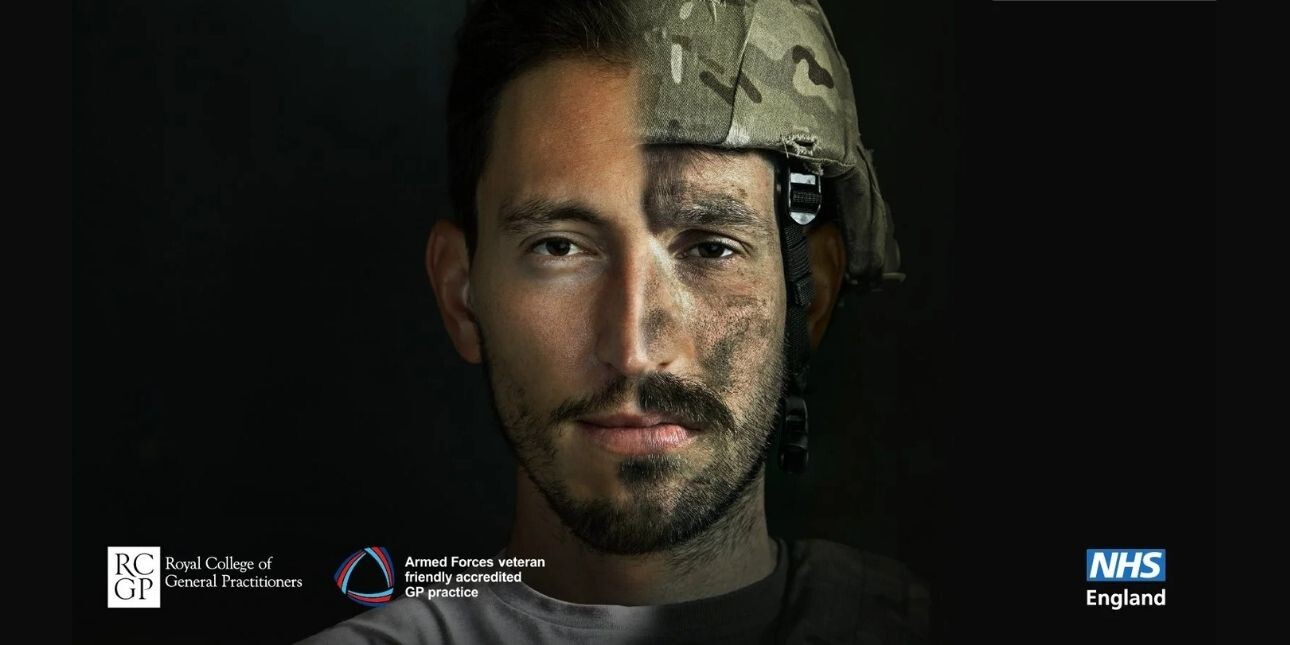
A campaign visual showing a digitised colour image of a white, male soldier's head and shoulders. His left side is civilian with short brown hair; his right side is in army helmet and uniform with camouflage paint on his cheek
Image: RCGP / NHS England / Evergreen PR
PUBLIC RELATIONS
Friday 31st October 2025

10 minute read

The award-winning PR campaign helping GPs better serve veterans

How strong news hooks, solid PR theory and striking visuals are influencing doctors’ understanding of the distinct health needs of England’s 1.74 million ex-forces veterans

Each year around 18,000 service personnel move from military to civilian life in Britain. Research shows that these veterans – also referred to as ex-forces or ex-service personnel – can have distinct health needs related to their service, including physical conditions such as tinnitus and musculoskeletal issues, as well as mental health challenges like PTSD. Despite there being 1.74 million ex-forces veterans in England alone, studies reveal a reluctance among this group to seek support, largely due to concerns that civilian healthcare professionals may not fully understand their experiences.

To address these challenges, the Royal College of General Practitioners (RCGP) launched the Veteran Friendly GP Practices programme in 2018, in partnership with NHS England. The voluntary accreditation initiative equips GP practice teams with education and best practice training, enabling them to identify, understand, support and, if needed, refer veteran patients to specialist NHS veteran healthcare services.

Campaign challenges and strategic shift

Initially, the programme saw strong uptake, with many GPs displaying the Veteran Friendly GP Practices stamp on their websites and surgeries. However, by September 2021, monthly sign-ups had declined to just 24 practices.

To reinvigorate momentum, Evergreen PR – a specialist healthcare communications agency founded in 2019 by chartered PR practitioner Leigh Greenwood – was brought in by the RCGP and tasked with doubling sign-ups to 50 that November, using Remembrance Day as a catalyst.

From his initial assessment Greenwood found there was support within the NHS for veterans, but most primary healthcare professionals (which includes GPs and practice nurses) weren’t aware of, or educated, on it.

“The campaign needed an audience-focused strategy to pinpoint the most influential strategic levers and maximise impact while minimising wasted effort,” he says.

“Our analysis of RCGP data revealed that GPs account for just 26% of a practice’s primary care workforce. Administrative tasks related to programme sign-ups are often handled by practice managers, nurses, and social prescribing link workers – key professionals who had not previously been targeted by communications.”

It was a short project with limited time and budget, requiring Evergreen to be smart and targeted with story development and a purpose-driven narrative.

The agency, which is based in Sheffield, broadened its outreach by developing news releases and toolkits for the healthcare trade media, professional organisations, and NHS England newsletters.

Greenwood says: “The accreditation programme is built on a simple premise: healthcare professionals cannot identify veterans by appearance alone. By routinely asking, ‘Have you or a member of your family served?’ practices can update patient records with a specific veterans’ code, which, along with the education, helps staff to identify and understand potential veteran-related health issues so they can offer the right support or refer to specialist NHS services if needed.

“We used existing academic research to bring to life the specific health issues that veterans experience, and the fact that many suffer in silence because they worry that a civilian healthcare professional won’t understand their needs.”

The tactical shift worked: 13 articles in key titles including GP Online, the British Journal of Nursing and the Practice Manager’s Association newsletter. The campaign exceeded its target, with 79 GP practices signing up – a 220% increase over the previous benchmark.

Contract retained

On the back of these results, the RGCP tasked Evergreen to produce three more campaigns to help it meet NHS England’s goal of accrediting 50% of GP practices in England by April 2024.

Budgets remained tight but Greenwood’s team created fresh narratives and topical news hooks, again linked to academic studies and external events, and used creative language to highlight the ‘hidden health needs’ and ‘silent struggle’ of veterans.

“Our second campaign, from April to June 2022, featured testimonials from practice managers, nurses, and GPs, allowing professionals to speak directly to their peers through relevant media channels. An average of 66 practices per month signed up over a three-month period on the back of 26 articles; while the third campaign in November 2022, got 179 practices signed up – more than double the previous record for a single month and 630% above the benchmark.”

The success reflects Greenwood’s ethos for the agency to “not focus on vanity metrics, broad media placements that don’t reach the target audience and extended reach through influencers” and instead prioritise strategic outcomes and tangible impact.

“Our question to clients is ‘what are you trying to change,' and then we ask ourselves what's the best way for us to achieve that?”

He credits the CIPR’s postgraduate diploma, which he undertook 10 years ago, for his thinking. “It sparked my interest in theory, strategy, outcomes, and the potential for PR to deliver tangible value and impact.”

This led to him developing Merto, a PR campaign planning tool which he previously blogged about for Influence. It helps health organisations identify the “most effective route to outcomes” by applying principles of behaviour science, prioritisation, and measurement to campaigns.

Creative evolution and audience testing

Despite the success, Greenwood and his team worried that the original campaign imagery, which focused heavily on military themes – such as service uniforms and family farewells – was a potential barrier to broader engagement.

“We felt it resonated with healthcare professionals already connected to the military, potentially alienating others within primary care. As PR professionals we know that if something doesn't feel immediately relevant to a consumer, they’re less likely to act on it.”

A campaign visual showing a digitised colour image of a white, female RAF veteran. The left half is in civilian attire, the right half in RAF uniform. A campaign strapline reads: The impact of service isn't always obvious.

To address this, Evergreen’s creative director redesigned the visuals and introduced a split-face concept: half-civilian, half-military. The approach visually communicated two core messages to GP practices: veterans cannot be identified by appearance, nor can their health needs be recognised without asking them if they’d served.

The new imagery included diverse representations of men and women of different ages, ethnicities and services, such as a white male soldier half-dressed in uniform with camouflage paint on one cheek, and a turbaned Sikh veteran in split civilian and Royal Navy attire.

Audience testing was integral. The messaging was influenced by feedback from veterans, primary care professionals and GPs who had served, ensuring sensitivity and relevance. The campaign’s tagline was softened; “The impact of service isn’t always obvious” replaced a more direct original version to avoid potential triggers.

“As a PR professional, you know that you’re never in control of where campaign material might end up or be seen. We always look at our material through a lens of ‘Will this be ok if it’s placed in front of a veteran?’ because we wouldn’t risk any messaging that was triggering for them.”

A campaign visual showing a digitised colour image of a Sikh, male Royal Navy veteran. The left half is in civilian attire, the right half in Royal Navy uniform. A campaign strapline reads: The impact of service isn't always obvious.

The campaign goes mainstream

The success of the split-face visual in driving media attention and sign-ups was a turning point. The government’s Office for Veterans’ Affairs (OVA) recognised the programme’s achievements and sought to sustain momentum from the 2023 Remembrance Day campaign into early 2024.

“With increased budget, the campaign expanded to mainstream media, including TV, newspapers, radio, and online platforms, encouraging veterans to inform their GP practices of their service, while maintaining engagement with healthcare outlets and stakeholders.

“We generated new primary data on veterans’ needs by conducting a survey of approximately 5,000 veterans from the OVA’s database. Insights revealed that health professionals’ perceptions of veterans are influenced by TV news, prompting a broadcast-focused campaign.

“The cut through was phenomenal with almost 170 media placements including the British Medical Journal, the Guardian, Independent, the Daily Mail and regional titles. We placed a 12-minute package on BBC Breakfast and a nine-minute package on BBC Morning Live, which featured veterans telling their stories alongside accredited practice staff.”


Greenwood credits the pairing of veterans and the healthcare professionals who supported them, for delivering strong and authentic emotional impact. Interviewees included an army veteran who spoke to the BBC about serving in Afghanistan and whose mental health was impacted by watching the Taliban’s return to power on television. His GP was able to recognise how the symptoms related to his service.

“The campaign utilised the Com-B model, which addresses capability, opportunity and motivation to influence behaviour. Emotional motivation was conveyed through stories of the human challenges experienced, as well as gratitude and positive outcomes, while rational motivation was supported by data demonstrating the prevalence of these experiences.”

Repositioning a trade campaign to a mainstream consumer audience wasn’t difficult, says Greenwood: “The narrative of the veterans’ accreditation programme didn't change enormously, just the way that the message was described.”

But it demonstrates the value of PR pros having strong relationships with journalists and TV researchers, he adds. (Greenwood has worked in healthcare PR and public affairs for 20 years, including long stints at the Oral Health Foundation and Slimming World prior to founding the agency.)

Over the four-month period, more than 100 practices signed up – quadrupling the original benchmark.

The split-face visuals have become synonymous with the campaign; a lesson for other communications professionals not to rush to replace a creative that works.

“PR campaigns need time to bed in with the audience. There’s a marketing theory called creative commitment – if you create something that delivers impact, don’t move away from it too quickly.

“Often marketing and communications teams change a creative and move on. They start to imagine that because we've spent so much time living and breathing this creative, that the audience has the same level of exposure when they usually haven’t.”

Award recognition

In July, Evergreen’s hard work was acknowledged when it won the CIPR Excellence award for best long-term campaign. Greenwood was accompanied on stage to receive the reward by Andy Riley of the RCGP – testament to the relationship that the organisations have built.

Four men stand on the purple lit CIPR Excellence awards stage.
| Left to right: presenter Ben Hanlin, Leigh Greenwood, Andy Riley, and the CIPR's Sukhjit Singh Grewal

“I’m grateful to the RCGP and the other bodies we worked with. They kept us updated with invaluable data, which we could use to prove impact, inform our decisions and adapt – like live sign-up conversions during the BBC Breakfast package aired or when we partnered with the Institute for General Practice Managers to deliver a webinar programme.

“None of this would have been possible without access to veterans and healthcare professionals whose lived experience shaped the campaign’s tone and direction. The long-term nature of the project allowed for continuous improvement; a benefit often missed in short-term campaigns.”

As public attention turns to commemorating the fallen and poppies sprout on lapels, Greenwood is proud that this Remembrance Day more practices than ever are accredited as GP veteran friendly – 4,400 (or 70%) at last count – and more veterans can feel confident that their healthcare needs will be met by an understanding professional.

Richard Dunnett is a journalist and content specialist, the web manager of Influence and head of content at Meet the Leader. He previously held senior publishing roles at Director (the business magazine of the Institute of Directors), Sky TV, various lifestyle magazines and within the internal comms department of the John Lewis Partnership.

Go behind scenes of these PR campaigns

Boots Hearingcare - inside the 'Do it for them' PR campaign featuring TV presenter Mark Wright

The remarkable story of the Help for Heroes campaign

Make Poverty History - the story of the first big charity campaign of the digital era