


Call in the administrators: protecting reputation during business restructuring
Insolvency can put huge pressure on a company’s reputation, but effective communications can help protect stakeholder relationships and preserve brand value.
Claire’s Accessories has been in the headlines repeatedly over the last year. Its collapse into administration, and the knock-on effects, have put the retailer – and insolvencies more generally – firmly on the public agenda, contributing to some of the highest levels of media reporting on insolvency seen in years.
In the midst of an insolvency, PR and communications can be an underappreciated function. But it is vital.
There is the immediate challenge of dealing with the scrutiny that particularly high-profile insolvencies attract. Then there is the less obvious job of protecting critical stakeholder relationships and preserving brand and reputational value, which, in some cases, may provide the foundations for a brand resurrection from the ashes of the collapsed company.
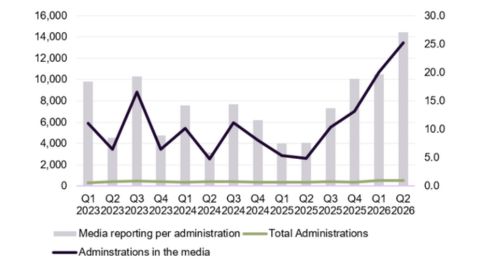
According to data from the Insolvency Service, administrations represented, on average, around 7% of company insolvencies between Q1 2023 and Q2 2026. Yet, looking at reporting in the UK media in the same period*, they accounted for approximately 78% of media coverage of insolvency.
Q2 2026 saw the highest volume of reporting across the whole period analysed. Interestingly, this did not coincide with a surge in overall insolvencies. These actually fell slightly in the opening quarters of 2026 compared with the same period in 2025.
Administrations were up, which will have played a part. But the spike in coverage was also heavily influenced by a handful of particularly prominent cases, most notably Claire’s, along with Quiz.
So why do certain insolvencies attract so much more attention than others?
Why some insolvencies become media firestorms
There are five factors which tend to shape how far an insolvency becomes a media firestorm, and the scale of the reputation management challenge facing business leaders, communicators and insolvency practitioners:
- Narrative: the story and reputational trajectory of the business, previous scrutiny, failures, rescues and management decisions.
- Personality: the involvement of prominent founders, executives, investors, celebrities or other figures who increase media interest.
- Locality: the impact on particular towns, communities, employees and local stakeholders, often amplified by regional media.
- Context: the wider economic, political or sector story into which the insolvency fits, such as high-street decline or changing consumer behaviour.
- Scale: the size of the business and the extent of the impact, including jobs, customers, creditors and geographic footprint.
Claire’s and Quiz tick several of these boxes.
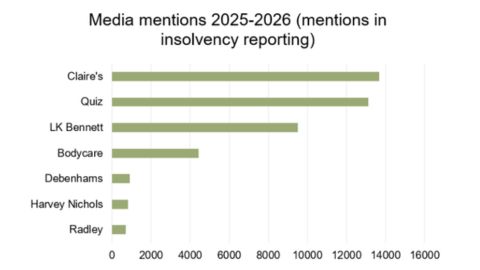
Both are familiar consumer brands with large stakeholder constituencies. Both also sit within a wider debate about the state of physical retail and changing patterns of discretionary consumer spending.
The memory of repeated failure
They also share something else: both are examples of what might be termed an ‘insolvency multiple’ – brands passing through successive rescue or restructuring processes. Quiz entered administration for the third time in six years. Claire’s returned to administration only months after an earlier rescue.
That matters because narrative, as a factor driving media interest and coverage, has memory.
Previous statements about turnarounds, fresh starts and sustainable futures do not disappear when ownership changes. They remain searchable and become part of the backdrop to whatever comes next.
It also gets to the heart of why communications during an administration cannot be treated simply as a matter of handling ‘bad press’.
Protecting the value that remains
Brand and reputation are important sources of corporate value and significant components of goodwill. Where a business continues to trade, confidence among customers, employees, suppliers and other stakeholders may be critical. Where a sale is being pursued, the strength and resilience of the brand may help preserve interest from potential buyers.
In some cases, the operating company has disappeared while the brand has survived under new ownership. LK Bennett is an interesting example of the value that can remain in a well-known name, even when stores close and suppliers and other unsecured creditors may recover very little.
That creates another communications challenge. Insolvency reporting can quickly move beyond what went wrong and into questions about who ultimately captures the value that remains.
Recent reporting in The Times on LK Bennett, for example, has included both references to the Princess of Wales wearing the brand adds a personality angle, while scrutiny over adviser fees provides another source of media interest.
Insolvency practitioners face a challenging communications environment in these situations. They have their own reputations to manage, alongside legal duties and the practical requirement to communicate clearly with employees, customers, creditors and the media.
There is often a difficult balance to strike between empathy, the legal position and clarity about the ultimate purpose of the process: delivering returns to creditors.
A situation where employees lose jobs, suppliers take a substantial hit and advisers receive significant fees can look uncomfortable when reduced to a few headline numbers.
Building a credible comeback
Turnaround comms can also be creative and bold. Bodycare collapsed into administration in 2025, but its new owners have since deliberately talked up a reinvention of the brand.
‘We’re so back’, its website claims, while a CEO-led media campaign has focused on retail transformation and new offerings like its influencer studios. A local paper proclaimed ‘joy’ at the return to the high street when Bodycare reopened its doors.
Time will tell whether that translates into strong returns. But it demonstrates how corporate and brand communications can reinforce a new proposition, with the company addressing some of the challenges that have seen others in the high-street category, including Claire’s, struggle.
Business restructuring can buy time. It can reduce debt, close stores, renegotiate leases or transfer ownership. Whether it can produce a business and brand that customers still want, and that can compete sustainably, is another question altogether.
Communications cannot solve that problem. But where genuine brand and reputational capital remains, it is important to make sure that value is not unnecessarily destroyed in the noise and scrutiny of corporate failure.
Tal Donahue is a director at Infinite, an accredited CIPR practitioner and former PR Week 30 under 30.
Further reading
As trust declines earned media becomes PR's most valuable asset
When transparency wasn't enough: lessons from communicating through liquidation
Why proving integrity matters more than ever for corporate reputation