
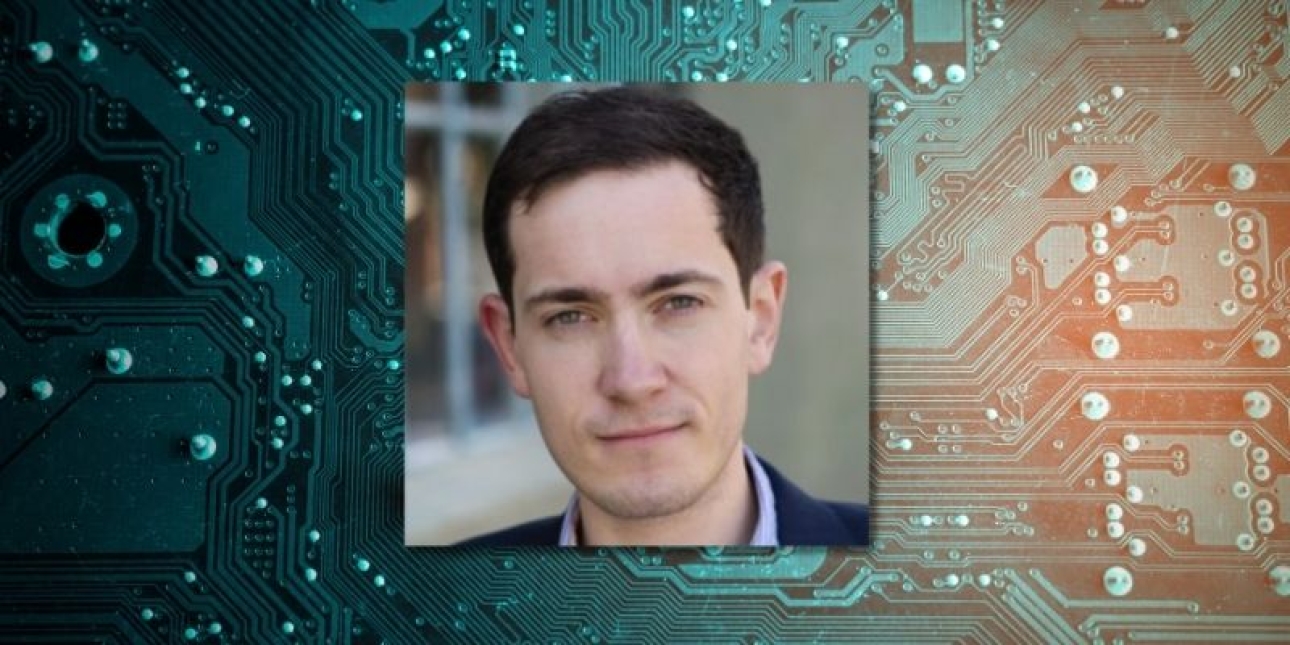
Ed Zitron: AI will be the tech equivalent of sub-prime mortgages
He’s the PR expert who traded press releases for podcasting – and now Ed Zitron’s Better Offline is where Silicon Valley tunes in to confront some tough questions about itself.
Ed Zitron has gained a significant following as the host of Better Offline – the fastest-growing tech podcast of 2024. He’s widely recognised as a prominent and outspoken critic of big tech and the growth-at-any-cost mindset that defines modern capitalism.
His insightful commentary has been featured in prestigious publications such as the Atlantic, Business Insider, and the Wall Street Journal, and he was recently profiled in the New Yorker magazine. He’s also the author of two books, with a third, Why Everything Stopped Working, due for release next year.
Born and raised in London, Ed’s career began at PC Zone, the renowned games magazine where Charlie Brooker launched his own career. He later moved to New York to work for a public relations firm before founding his own company, EZPR, in 2014. Specialising in PR for tech companies and startups, he continues to run EZPR while splitting his time between New York and Las Vegas. Alongside his business, he produces Better Offline and authors the popular Where’s Your Ed At newsletter.
I always wanted to write about games. Other than what I’m doing right now, being discs editor at PC Zone was the best job I’ve ever had. The people I worked with there may never know how much they changed my life.
I learned about how to enjoy writing at PC Zone. I would finish my work, then be offered other people’s work and finish their work too. It wasn’t because they weren’t working; they were diligently getting on with their jobs. It’s because I write really fast. A lot of my [success] has come down to people giving me a chance, and I keep working until I’m allowed to do more.
I was misled as to what PR was before I came to America. I wanted to leave London and applied for jobs everywhere and got one at a PR agency in New York in 2008. I’d read all these books, and they made it seem like this thing where people treated you with dignity and respect. Also, what most people in America perceived to be PR was not PR. They all gave the impression they wanted to do anything but media relations, yet every client wanted to pay for media relations.
I guess my thing is that I know roughly what every journalist I deal with is covering at any given time. That comes from endless reading and actually knowing the subjects. I pride myself on knowing as much the journalist. I don’t mean that in a condescending way. I mean one can aspire to know more, but not actually know more, if that makes sense.
Read what the journalists write! So many PR people still don’t do this and it’s actually the most obvious thing that hasn’t changed about the job.
San Francisco now reminds me of London and not in a good way. I started EZPR around 2013 and moved to San Francisco. It was a lot more friendly and open than New York. It was a little more optimistic back then, and there were a lot more people you could simply meet for a coffee. A lot of them have moved on. And weirdly enough, things have flipped again between San Francisco and New York.
I ended up doing enough good work for enough people that my name got around at the startup accelerator Y Combinator. I’m heavily referral based and don’t really do outgoing business. It always shocks me how many firms out there are well known for doing bad work and still get business.
A lot of companies and executives feel the need to comment on everything. It happens regardless of whether it’s intelligent or indeed considered.
People have been saying media relations is dead since my career started. That’s really funny, because it seems to be alive and well. There is, however, a lot more niche journalism happening. There are outlets doing really incredible journalism who are never going to be good pitch targets. There are fewer people doing straight profiles, and thus you have to be very aware of what they’re doing to find stuff that will be a good fit.
An example of a campaign I really liked was a company called Skydio. They make drones. At their launch event, they had (former New York Times columnist) Farhad Manjoo being chased by a drone through a forest. Anything where you really put some thought into what the journos will like, let them play with it and get into the guts of it, is usually a good way to go.
I started my newsletter, Where’s Your Ed At in 2019, did four and then gave up. The first thing I posted got 63 views. Then I got Covid at the end of 2020, just before the vaccine was available. I remember sitting in a room thinking I’m going die, so I thought it ‘I may as well go out blogging.’
I know it doesn’t sound particularly artful, but I just didn’t stop writing. I went from 300 subscribers to 4,000 by the end of 2021 (and will soon hit 70,000). In the middle of 2023, I thought I would stop. I was quite depressed at this point and needed to make some changes in my life. Then, in August 2023, Robert Evans reached out to me. He does the Behind the Bastards and the It Could Happen Here podcasts and runs Cool Zone Media.
The thrust of my podcast Better Offline [below] is this growth at all costs capitalism and what the elites have done as a result. At first I thought ‘How am I going to 46 episodes a year about this? That sounds insane.’ I clocked in at 82 episodes for 2024.
What started me thinking about this were all the articles published in 2020 and 2021 about why we need to go back to the office. It was usually a manager or a CEO being quoted in and all these journalists credulously saying ‘yeah, absolutely.’ Why couldn’t they ask, ‘How much time do you spend in the office?’ And what about the workers? Nobody talked to them. I love remote work and EZPR has been remote from beginning. The forces that control capital do not like labour, and that sounds very Das Kapital to say that, but it’s there.
When I started Better Offline, there was a Reddit page with people complaining about the show. I mean they were straight up demolishing me. Then I did an episode on Peak AI. I went to read it, but I also had strep throat. Important detail. And then afterwards, I told Robert and Sophie Lichterman (executive producer at Cool Zone Media). They were like, ‘You should have taken a break’, but I did that episode and sounded crazy and aggressive because I was on steroids. I thought, these people are gonna think I’m a nutter but instead I got emails to people saying ‘thank you. You put into words the frustration I’ve been feeling with everything, too.’
People don’t realise how bad things are in AI because everyone’s acting like things are good. A lot of these startups are not profitable, and horribly unprofitable in some cases. OpenAI and Anthropic have jacked up their rates for their enterprise customers, so it will make these crazily bad margins even worse. Eventually, that will price people out of running these companies. It will be the tech equivalent of the sub-prime mortgages.
I adore my work. I get to write for a living. I get to do PR, talk to journalists, and I can read stuff that I find interesting all day long. And it’s for my job. I don’t have to justify why I’m reading all of these books. I can just do it. Honestly, if things were good, I’d write about that just as much. I wish things were positive, but they’re not right now.
Discover more about Better Offline.
![]()
Ryan Herman is a journalist, author and editor. His latest book, And Finally… The Weird and Wonderful World of News, is out now from Pavilion Books.
Also by Ryan Herman
How golf influencers and PR helped the game get its groove back
Norad Tracks Santa: the PR campaign that won hearts worldwide
.jpg&w=728&h=90&maxW=&maxH=&zc=1)
