

The PR industry is changing fast. This is why you can't ignore regular training
CIPR trainer and Chartered PR practitioner Alison Arnot explains why training helps comms professionals move beyond outputs and instead focus on outcomes, impact and long-term value.
Alison Arnot is a consultant, trainer and author with over 25 years’ experience in PR, internal, crisis and change communication. A Chartered PR practitioner and CIPR Fellow, she delivers a wide mix of open and in-house internal and external comms CIPR courses, which reflects her industry experience and areas of interest. [Page down for the full list of upcoming courses that Alison teaches.]
In this interview, Alison tells us how training helps PR professionals build the confidence to demonstrate to leaders how PR strengthens reputation, improves relationships, influences behaviour and supports business objectives. She also explains how the right training helps practitioners think more strategically, use tools such as AI more effectively without losing sight of human judgement, and contribute meaningfully to leadership discussions.
Alison is a Strategic 26 winner and Independent Impact honouree. Adding to these credentials, her book Internal Communication in Times of Crisis is a 2026 Business Book Award finalist.
Many PR professionals are struggling to demonstrate their value to decision-makers within organisations. I’ve worked, trained and consulted in PR for over 25 years now, and I have seen the industry change a lot. We keep getting better at creating content, developing channels, and measuring output and out-takes. Yet, many professionals I talk to say they still struggle when trying to connect their advice to specific organisational outcomes or impact.
We need to be able to articulate why our work matters. How did it strengthen reputation? How did it improve relationships? How did it influence behaviour or support broader business objectives? Knowing the answers to questions like these are important.
The obsession with using AI to work quicker and produce more is risky. Lots of delegates ask me how they can use AI to work faster or more efficiently. This shouldn’t be our only focus.
AI can enhance capability, but it can’t replace judgement... yet. Public relations, at its core, is about human relationships, so we need to protect and continue to build human skills... We need to continue building capability at every level of the profession. This means not only learning how to use new tools effectively but also learning how the work is done well in the first place, then strengthening the ability to think strategically and demonstrate value over the long term.
The conversation about PR having a seat at the table never goes away. It matters because PR professionals do need to be in the room and involved when decisions are being discussed and thinking is still being shaped, rather than pulled in after plans are in place.
PR professionals need to contribute more if we’re to keep a seat at the table. It's not just about presence. Today’s PR professionals must be confident and capable not just in advising how best to deliver a piece of content, but in sharing insight that helps their organisations make better decisions. This means making connections between action and reputation, and it means helping leaders understand how different messages and activities will be interpreted and acted on. It’s important that our training reflects that.
Too many people believe PR is all about ‘outputs’. It’s a big misconception, especially given the industry is as much about listening and sense-making as it is about sending out information. Great PR is about understanding what different stakeholders think, feel and expect, and then using that insight to help organisations engage appropriately and ethically to meet their set objectives.
Always ask “Why?”, not just “How?” I invite people on all my courses to consider “Why?” as often as they do “How?”. I also encourage them to think about what they want the learning to do for them now and in the future.
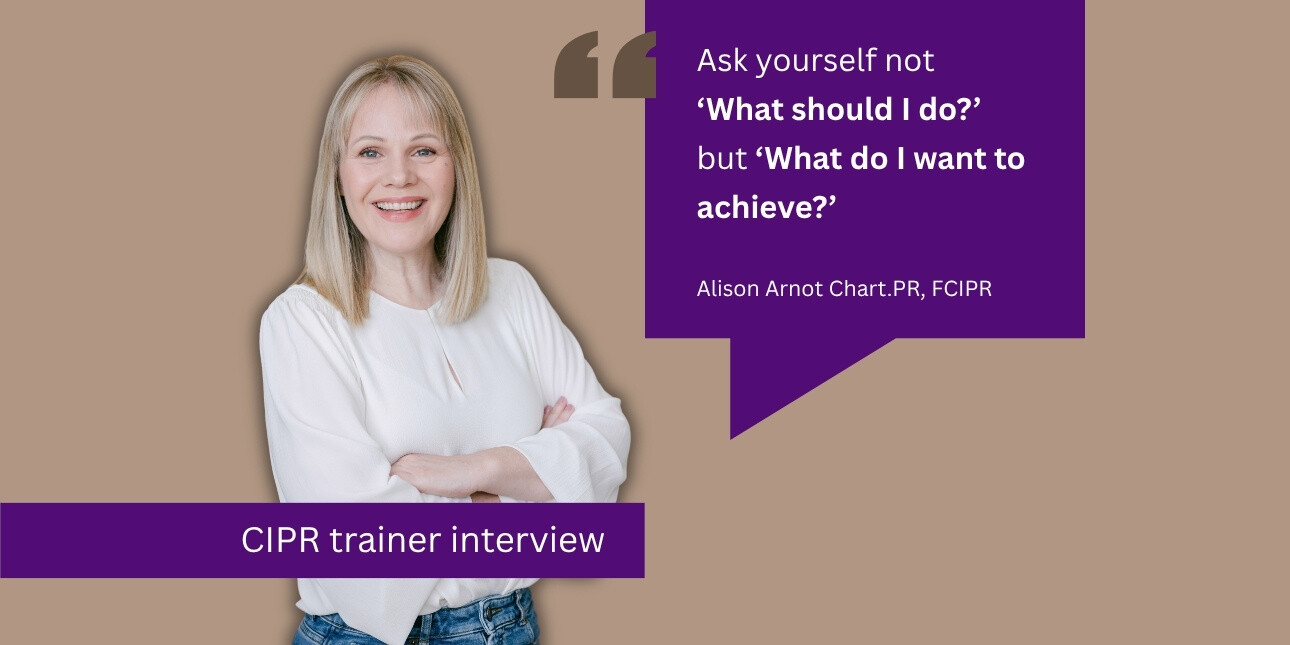
The most powerful mindset shift a PR professional can make is... to think ‘What do I want to achieve?’ instead of ‘What should I do?’. Once you're clear about the outcome you want, learning becomes less abstract, and the training becomes more about capability building and impact. That's where it really shows its value.
My CIPR courses are delivered at different levels. From graduates and apprentices taking their first steps into their career through to senior managers leading through quite complex situations, they all have different needs. All of them also deserve an experience that is accessible, inclusive and grounded in real practice.
The most useful learning happens when delegates share their reflections. To achieve this, I tailor every conversation to the people in the room. I blend the theory with my own observations and try to create an environment where delegates can talk openly about their own experiences and explore common challenges from different perspectives.
What people like most about my training is... that it’s grounded in real-world insights. They also value the fact the learning is practical and immediately applicable in their own organisations. Most describe my delivery style as confident, but also warm and informal.
Sign up for one of Alison Arnot's upcoming training courses
*All virtual, except Edinburgh
Employee engagement
Wednesday 9 September
*Strategic thinking in PR
Tuesday 15 September (Edinburgh)
Strategic internal communication
Wednesday 23 September
Monday 23 November
Introduction to PR
Wednesday 21 October
Strategic internal communication
Wednesday 23 September
Monday 23 November
Internal communication in a time of crisis
Thursday 26 November
Change communication
Wednesday 2 December
Looking for a different PR or communication training course?
The CIPR is the PR industry's leading trainer provider. Find the course that suits your development needs to help you on the next stage of your career journey.
Further reading
How a CIPR trainer helps PR professionals tackle today's biggest communications challenges