


Why are so many communications professionals missing from the boardroom?
In volatile times, boards are judged not only by their decisions but by how those decisions are perceived. Strategic communications is central to that challenge.
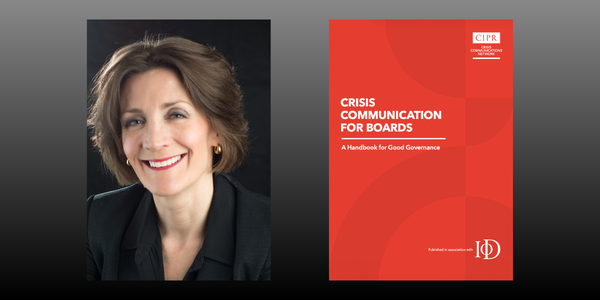
On Monday 14 September, the CIPR Crisis Communications Network released a new handbook, Crisis Communication for Boards. Published in association with the Institute of Directors (IoD), it establishes strategic communication as a core governance responsibility, sitting alongside risk oversight, fiduciary duty and long-term value creation. It explores what boards need to consider long before a crisis surfaces, as well as how they should respond when it does. Structured around the full crisis lifecycle, the handbook takes a broad strategic view while also offering practical guidance, templates for best practice, and a range of special features and case studies contributed by leading academics and practitioners from around the world.
Shaping decisions
A practical resource for directors, the handbook is designed to help boards think more clearly about crisis as a dynamic lifecycle: starting with early identification of risk, evolving through preparation and decision-making under pressure, and culminating in recovery and the rebuilding of resilience and trust. However, its real significance lies not only in what it says to boards, but in what it implies for our profession. As every communications professional knows, communication is the golden thread that runs through every aspect of an organisation’s activity. It is not something to be applied in response to difficulty; it shapes how organisations think, act and decide from the outset, sitting alongside oversight, preparation and strategic judgment.
Unfortunately, in practice, many organisations don’t work like that. Too often, communications professionals are brought in late, perhaps to steady events already in motion or to explain decisions that have already been taken. Yet so often the defining moments occur much earlier – when risks are identified, problems are framed, and stakeholder expectations are understood. This is where communications has its greatest impact: not in managing reactions, but in shaping decisions.
My own journey, from a first career in law to my second in strategic communications, public affairs and governance, has given me a close view of how much is lost when boards fail to recognise the full strategic value of communications. Over the past seven years, I have worked actively to change this: not only in how boards understand communications, but also in how our own profession understands its relevance at that level.
A source of insight into risk, judgement and legitimacy
On the one hand, many boards still hold a limited view of what senior communications professionals can offer. Communications is often perceived in functional terms – messaging, media, profile – rather than as a source of insight into risk, stakeholder judgment and organisational legitimacy. Perhaps that is understandable as historically the function has often been positioned at the point of execution. However, in an age of volatility and unpredictability, that no longer reflects reality.
Communications professionals bring to senior decision-making something few other disciplines can offer in quite the same way: an understanding of how risk, reputation, stakeholder expectations and trust interact in real time. We are often described as “sense-makers-in-chief”. We understand not only what an organisation intends to do, but how it will be interpreted, tested and judged. We see the distance that can open between strategy and perception, between intention and impact. We are often the first to recognise when language, behaviour and stakeholder expectation begin to move out of alignment. These are not peripheral observations: they go directly to the quality of decision-making, governance and leadership.
Is the communication industry lacking self-confidence?
At the same time, there remains a lack of confidence within the profession itself. Many highly capable communications professionals still underestimate the strategic value of what they know, or assume that board roles sit more naturally with legal, financial or operational backgrounds. Of course those disciplines are indispensable, but modern boards do not operate in a world where governance can be separated from public judgment, stakeholder expectation or the interpretation of decisions under pressure. Reputation can have commercial, regulatory and operational consequences. In that context, communication is not incidental: it is part of how leadership functions.
A strong understanding of crisis makes this particularly clear. Crisis strips away abstraction. It reveals organisations quickly and without ambiguity. It exposes the strength – or weakness – of leadership, culture, governance and judgment. Under pressure, issues that might otherwise remain hidden become immediately visible: indecision, poor escalation, fragmented thinking, lack of clarity, misalignment between words and actions, and uncertainty about who matters and why. Equally, strengths become visible too: discipline, coherence, preparedness, honesty and credible leadership.
Consequently, those who understand crisis are able to draw upon deep insight into how organisations behave when it matters most – a perspective which is critical at board level.
Senior communications practitioners are well placed to contribute far beyond conventional functional boundaries. We can support boards on issues of accountability, stakeholder risk, leadership visibility, public legitimacy and long-term resilience. We bring a perspective that is both strategic and practical, combining judgment with an understanding of how decisions are received by regulators, investors, employees, media and wider stakeholders. In sectors where scrutiny is high, where trust is material, or where public confidence can alter commercial or regulatory outcomes, that insight is not optional. It is valuable boardroom intelligence.
Connecting the board to strategic communications
And yet the disconnect persists. Boards do not always see the full extent of what strategic communications can offer. And communications professionals do not always assert their relevance with sufficient confidence.
If we are serious about changing this paradigm, both sides need to move. Boards need to engage more actively with communications as a strategic capability – one that supports governance, risk management and decision-making, not just visibility or message delivery. Communicators, in turn, need to speak more comfortably in the language boards use themselves: governance, judgment, accountability, resilience, trust and long-term value. We need to be more willing to step forward for trustee and non-executive roles, and to describe our contribution in terms of the strategic choices we inform, rather than the outputs we produce.
The new handbook offers an opportunity to our profession
Although written for boards, the handbook makes a wider professional case. It shows, in practical terms, that communication belongs inside the architecture of leadership rather than outside it. It reinforces the idea that preparedness, judgment and accountability are not separate from communication but interwoven with it. It also helps to make visible the strategic value that experienced communications professionals can bring to organisations operating under pressure.
If this handbook does anything beyond helping boards prepare better for crisis, it should also force a more honest reckoning, both within boardrooms and within our own profession. Boards can no longer afford to underestimate the strategic value that communications professionals bring, especially in environments shaped by risk, scrutiny and consequence. Equally, communications professionals can no longer afford to underestimate themselves. If we are serious about being better respected, better valued and better represented at board level, we need to stop waiting for recognition and start asserting our own relevance.
The opportunity is there. The question is whether we are prepared to claim it.
Crisis Communication for Boards: A Handbook For Good Governance is available to download now.

Chartered PR practitioner Katherine Sykes is the co-chair of the CIPR Crisis Communications Network and CEO of Marland Sykes Communications.