

Burnham’s words fly where Starmer’s sank – because he has something to say
Andy Burnham’s communications are winning praise. But the real lesson for comms professionals isn’t his TikTok strategy. It’s the clarity of his ideas.
A year ago, Andy Burnham left Labour conference in Liverpool as the butt of jokes from the main stage. On 29 September, in the same city, he delivered a speech that Patrick Maguire predicted Labour will "talk about for years". One Labour MP compared it to Bill Clinton's address to conference in 2002: "It really felt like he was speaking off the cuff but was so spellbinding".
Such praise is rare, and all the more striking because the policies were hardly crowd-pleasers. Burnham told the hall that he would adjust the pensions triple lock, one of the hottest potatoes in British politics, to fund free social care. And yet a snap YouGov poll found 48% support for the measure, against 28% opposed. When Survation showed voters clips of the speech, 69% felt positive about the changes.
Burnham v Starmer
Contrast that with Keir Starmer, whose best speeches were still dismissed as boring and out of step with how people now consume political news. The easy conclusion for our industry is that the prime minister simply has a better comms team than his predecessor. I think that misses the real lesson.
Start with the words. Burnham's language is conspicuously plain: short sentences and evocative descriptors. "Someone has to go through the pain barrier and rip the plaster off," he said of his triple lock reform. These are sporting and domestic metaphors, physical and familiar. They do several jobs at once: they admit that the policy will hurt, they frame enduring the hurt as an act of courage, and they cast him as the one willing to bear the cost: "I accept I may pay a political price".
That directness invites an uncomfortable comparison. Voters who backed Donald Trump often said they like how he "says things as they are". Nigel Farage has built a following of millions on the same promise. Directness, it turns out, is a political asset in its own right, largely independent of the ideology it carries.
Burnham has borrowed this directness but inverted the mechanism. Where Trump manufactures dissonance – a deliberate clash between words and reality, superlatives and binaries that force listeners to either reject his claims or rationalise them – Burnham resolves it. He names a gap his audience already feels – between the promise of "Change" and the reality of rising bills – then offers a resolution: a specific idea, a named cost, and a personal commitment.
Starmer did try to be honest too. In the summer of 2024, he warned that things would "get worse before they get better". But honesty without vision reads as pessimism. Where Burnham's pain metaphors ("rip the plaster off") imply a wound that heals, Starmer's warnings offered only the wound. There was no named destination to make the pain worth bearing, and no visible act of personal risk to make the messenger trustworthy.
A speech is content
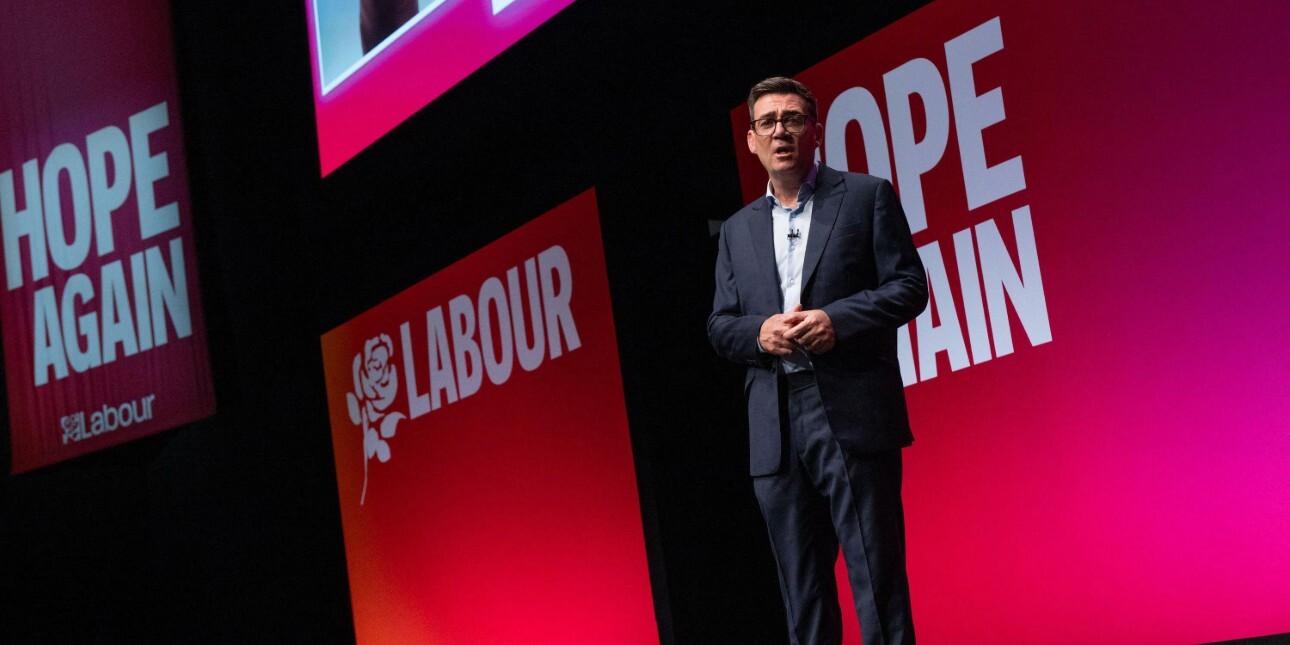
Burnham also understands that a speech is not just a speech: it is content. A behind-the-scenes camera beamed him on to the big screens as he walked on "like a popstar" to The Farm's All Together Now, his "rallying call to the country". He paced rather than stood, and left long silences, including one of almost a minute before he spoke about his late father. This was a conference speech built like a vertical video: intimate, energetic and emotional.
The same instinct drives his social-first operation of handheld videos, minimal polish and collaborations with creators such as Bus Aunty and Max Klymenko, drawing roughly 850,000 views per Instagram post, against around 254,000 for Starmer’s final posts. Part of the reason for its success is that posts are funny – but the humour is never merely decorative. A video defending the northern word “barm” for a bread roll pivots into an argument for devolution. A pub-snack ranking with the chancellor, John Healey, carries a tax cut for hospitality venues. The format is the vehicle; the idea is the cargo.
That last part matters because there are three lessons that could easily be taken from Burnham that would be wrong.
The first is that pumping out social posts is the answer. Starmer's own TikTok account showed what happens when the format arrives without the idea: a press release trimmed to 60 seconds. As Stephen Maycock of Ogilvy wrote for LBB, “people don’t come to Instagram or TikTok to consume policy, they come to consume people”. Borrow the format without a clear proposition and you get content for content’s sake, which audiences increasingly see straight through.
The second is the idea that going direct means bypassing scrutiny. Burnham has rationed traditional interviews in favour of ask-me-anything sessions on Reddit and friendly creators, and critics argue this lets his team choose the questions. This is a real risk: leaders around the world have used social media to dodge accountability. But Burnham's speech was followed by a full morning broadcast round, a sign his team sees social reach and traditional scrutiny as complements, not substitutes.
The third is that likability is a strategy in itself. The slickest TikTok in the world is useless if there is nothing underneath it. Burnham's videos work because each one carries a simple, salient idea that voters can hold in their heads: a £2 bus fare, free social care for those who need it.
Any practitioner will recognise the underlying lesson from client work. When a campaign isn’t landing, the instinct is to fix the channel: a new platform, a new format, a new spokesperson. More often, the problem is upstream. No amount of channel strategy can fix an unclear proposition. Communication is not a veneer applied once the thinking is done; it is the test of whether the thinking has been done at all. Burnham’s TikToks would be useless without something to say – and so would ours.

Isabella Goldstein is a freelance purpose-driven communications consultant. She has written on political language for LabourList and openDemocracy.